Why I Built InstaBid After 30 Years Swinging a Hammer

The short version: In 2004 I spent three thousand dollars on Xactimate. I plugged it in, it looked neat, and I could not figure out how to do a single thing with it. The disc went back in the box, and I can still picture that box sitting on my office floor collecting dust. Twenty-two years later I built the thing I actually needed. You talk, or you type, or your customer fills out a form. A real itemized bid comes out the other end — your prices, your markup — in about two minutes. Here’s how I got there.
The box on the floor
I want to start with the three grand, because it’s the honest part.
I wasn’t complaining from the sidelines about tools I’d never tried. I bought the industry standard. Real money out of a real checking account, in a year when three thousand dollars was a lot of money to me. I thought it was going to dial in my pricing down to the screw on every remodel I did.
I pulled it out of the box. Plugged it in. It looked great. And I couldn’t do a damn thing with it.
So the disc went back in the box, and the box went on the floor, and it sat there gathering dust while I thought: what a waste of money.
Here’s the thing — that wasn’t a software problem. It was a life problem. You get home at seven. Dinner, kids, tomorrow’s material run, a sub who didn’t show, a homeowner who’s texted you twice. The idea that you’re going to sit down that evening and teach yourself estimating software is a fantasy invented by people who have never done the work.
What this was supposed to be
I want to be honest about what I set out to build, because it was almost nothing.
One page. One calculator.
A homeowner types in a few things about her kitchen, and it hands back a number — somewhere around ten thousand dollars. That vague. No line items, no materials, no labor breakdown. One fuzzy figure and a form that captures her name and phone number so the contractor gets a warm lead instead of a cold one.
That was the whole idea. A lead magnet. A widget you’d bolt onto a website and forget about.
I got two or three weeks in before I understood what I actually had my hands in.
Because once you start asking why the number is ten thousand — what’s the cabinet grade, what’s behind the wall, what does the tile actually cost at the counter, who’s swinging the hammer and what does he charge — you can’t stop. Every answer opens three more questions. And every one of those questions is one I’d been answering in my head on job sites for thirty years without ever writing any of it down.
That widget was supposed to say one vague number. What it turned into prices 25,533 of them, by hand, line by line.
I’m still not entirely sure how that happened. I didn’t sit down to build a company. I sat down to build a form. Somewhere in there I stopped building a lead magnet and started writing down everything I knew, and it turned out that was the thing worth building all along.
The part I’m not proud of
I could walk a job and know the number in about two minutes. Thirty years in, that’s not bragging — it’s just what happens when you’ve bought the material, hung the drywall, eaten the change orders, and run crews for three decades. The number was never the hard part.
The hard part was the eight-hour write-up. Measuring it out, pricing every line, formatting something I wasn’t embarrassed to hand somebody.
And I dodged it. For days. Sometimes weeks. I’d have the number in my head and I would not sit down and produce the document, because after ten hours on a site the last thing on earth I wanted was a spreadsheet.
You know what happens then. They wait. And they wait. And eventually they stop waiting, because somebody else got them a number on Tuesday.
I lost thirty years of jobs to paperwork. Not to pricing, not to being outbid. To paperwork.
Turns out it’s not just me
For a long time I assumed that was my personal character flaw.
Then I read the Harvard Business Review study. In 2011, three researchers audited 2,241 U.S. companies — they sent each one a real inquiry and timed how long it took to get an answer. (Oldroyd, McElheran & Elkington, HBR, March 2011)
24% took more than 24 hours. And 23% never responded at all.
Almost half of all businesses either take more than a day, or never answer. That’s not a contractor problem, that’s an everybody problem — but it hits us hardest, because we’re the ones out on a roof when the phone rings.
Same study: answer inside five minutes and you’re 21 times more likely to qualify that lead than if you wait thirty. Not thirty hours. Thirty minutes.
- 2,241U.S. companies audited (HBR, 2011)
- 24%took more than a day to answer
- 23%never answered at all
- 21×likelier to qualify a lead inside 5 minutes
So I went and checked it myself
I didn’t want to take a research paper’s word for it, so I ran my own version.
I got on HomeAdvisor like any homeowner would and contacted twenty contractors.
Two called me back.
Twenty inquiries. Two responses. I sat there looking at eighteen contractors who never answered a person actively trying to give them money — and I’d been one of those eighteen for most of my career.
That’s when this stopped being a side project.
Because here’s the other half of it, and it’s the part that got me: there is a homeowner on the other end of every one of those eighteen. Somebody with a leaking roof and a kitchen they hate, who has learned that finding a contractor who will simply call you back is one of the genuinely miserable experiences of adult life. They’re not being picky. They just want somebody to answer.
Two minutes, a real itemized estimate, in their inbox. That’s not a software feature. That’s the thing they’ve been unable to get.
I’m not going to throw a big number at you about how often the first guy wins — you’ll see 78% quoted all over the internet and I went looking for where it came from and couldn’t find a real study behind it, so I’m not repeating it. The honest version is that somewhere between a third and half of jobs go to whoever answered first, and the Harvard numbers above are the ones with an actual methodology behind them.
That’s enough. It was never about being the cheapest. It was about being the one who called back.

Why nobody built this
Not a conspiracy — just economics.
The industry builds software for companies with a purchasing department. The 40-truck operation with an office manager and a controller. That’s where the contract value is, so that’s where the software goes.
Nobody builds for the guy running $150,000 a year with a helper and a truck. To this whole industry, that guy is “just a dirty roofer.”
That roofer has three kids. He’s better at his trade than most of the people selling him software are at theirs. And he’s the one getting buried — doing the estimating, the invoicing, the scheduling, the follow-up, and the actual work, alone, at the kitchen table, after everyone else went to bed.
This is for him. I’ve been him.
What I actually built
-
Two minutes, not an evening.
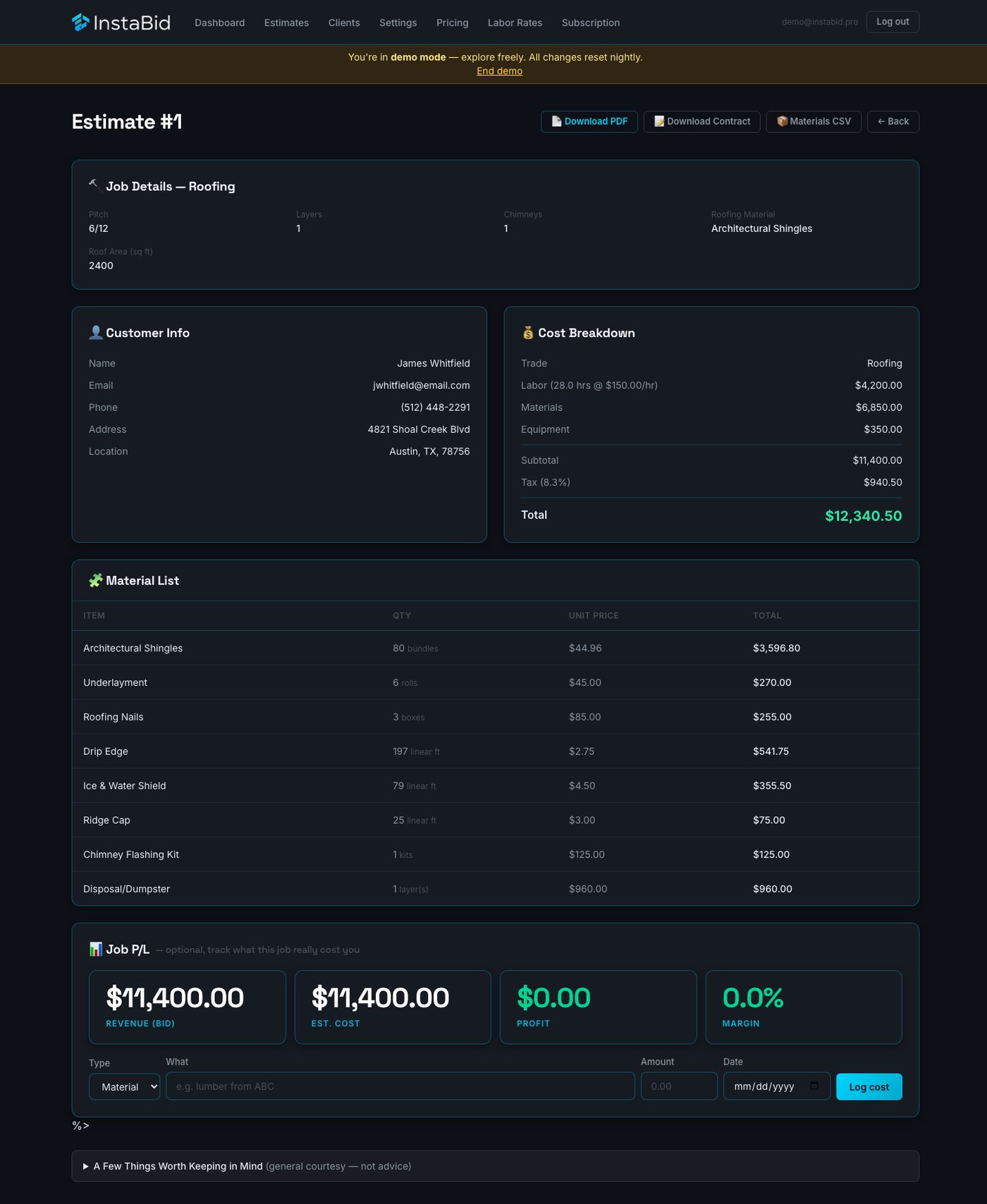
Walked job to a line-item PDF your customer can read.
-
Your price. Always.
The engine gives you cost — real materials, real labor, adjusted for your region. Your markup goes on top and it’s nobody’s business but yours. We don’t take a piece of your job. Change any price you want and yours wins from then on, permanently.
-
Show the work.
Open any line and see where the number came from — the part, the unit, the labor. The going standard in this category is to hand your customer a number a chatbot guessed at, with a note underneath telling them to verify it before sending. Read that again. That’s a company saying I guessed, you check it. We’re not doing that.
-
Nothing goes out until you say so.
The estimate is drafted, priced, and sitting there — and it doesn’t move until your thumb says go. Leave it that way forever if you want. Your leash, your setting.
-
Three ways in, one brain behind them.
Your customer fills out a form on your site. Or you call your own line from a roof and say the job out loud. Or an AI walks the kitchen with them on video. Same engine, same number, same PDF.
That third one exists because of Mrs. Smith. You’re driving to work and you remember you never sent her the estimate last night. Old way, that’s another lost evening or another lost job. Now you say it into the phone from the truck, keep driving, and it’s out before you park.
Why this exists
Somebody asked me why a guy who just wanted to pound nails and build cool stuff went and built software.
Because I was the customer. I bought the box in 2004 and never got it open. I did the Saturday-night calculator for three decades. I lost jobs I should have won because I couldn’t stand to sit down and type them up.
So I solved it. For both of us.
Start free at instabid.pro. Thirty years of straight talk on building, pricing, and running the business — Around the House, over a million listeners a week.
Stop losing jobs to paperwork.
Walk the job, talk it out, and a real itemized estimate goes to your customer in about two minutes. Early adopters get their first 90 days free.
Claim an early-adopter spot →