How It Works
There’s no trick to it. You get the job description in — however is easiest at that moment — and a real itemized estimate comes out, priced at your numbers, ready to send.
The part that matters is what’s behind all three doors: the same engine, the same catalog, the same math. A job you type and a job you talk through land on the identical number. That’s not a convenience feature — it’s the whole reason you can defend the bid to a homeowner.
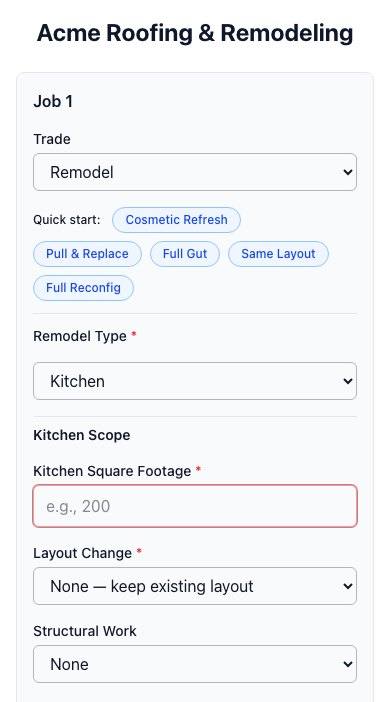
Door one: your customer fills out the form
-
It lives on your site.
About five lines of code onto WordPress, Wix, or Squarespace, and there’s an estimator on your page taking real jobs.
-
It’s your form, not ours.
Add your own questions — yes/no, multiple choice, a number, free text — and wire each one to your own price. “Semi-gloss, add $150.” “Extra can lights, $300 each.” The homeowner answers them and the math already knows what you charge.
-
They see a number on screen immediately
, then the PDF hits their inbox. Photos upload with it, so you’re not guessing at what “the bathroom” means.
Door two: you call your own line and say the job out loud
You’re driving to the next job and you remember you never sent Mrs. Smith her estimate.
Old way, that’s another lost evening — or another lost job, because somebody else got her a number on Tuesday.
You call your branded number, describe the work, and keep driving. The estimate is drafted before you park.
411 Voice is built end-to-end and launching — it’s not open to contractors yet.
Door three: an AI walks the room with your customer on video
The one that sounds like science fiction until you watch it work.
It joins a video call and actually looks at the room. Not a chatbot reading a script — real field intelligence. Are there outlets next to the sink. Do the cabinets run to the ceiling. How many fixtures are in here. It counts what it sees and asks the follow-up a thirty-year GC would ask.
Then it renders the before-and-after so the homeowner can see the finished room while they’re still standing in the old one.
LIVE is running real walks and launching. Separate product from 411 — different job, different pitch.
What comes out the other end
-
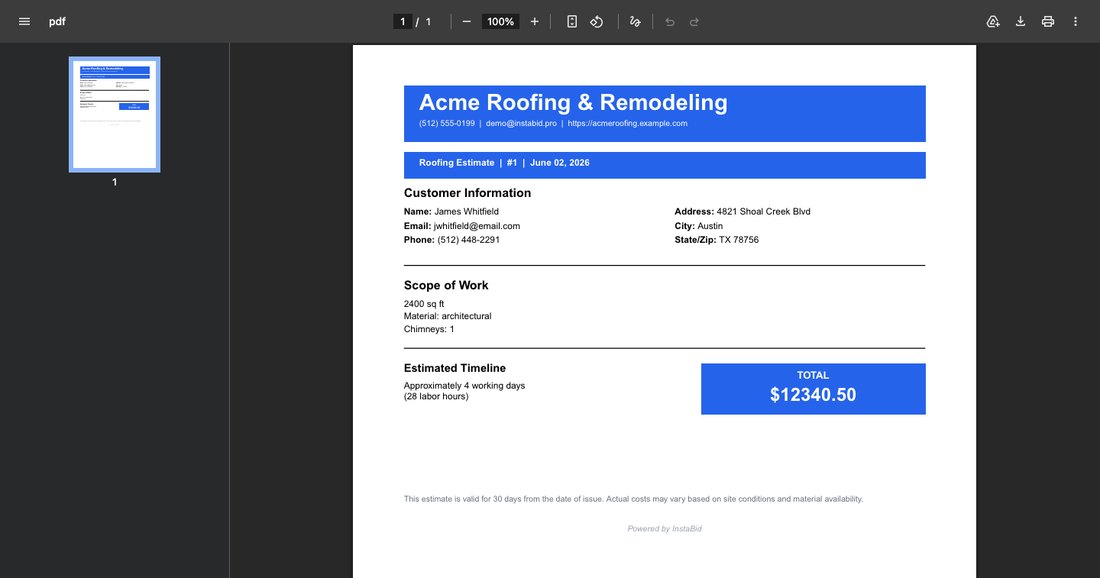
A real itemized estimate.
Materials and labor, line by line, adjusted for your region, your markup on every line. Not a range. Not a ballpark.
-
A PDF that reads like a contractor wrote it
, under your logo, that a homeowner can actually follow.
-
Open any line and see where the number came from
the part, the unit, the labor. The going standard in this category is handing your customer a number a chatbot guessed at, with a note underneath telling them to verify it. That’s a company saying I guessed, you check it. We don’t do that.
-
A trade-grouped pull list
, in the order the counter would pick it. Download it as a spreadsheet and send it to your guy — the hour you’d have spent building that list by hand is already done.
Then the part nobody else finishes
Most estimating tools hand you a PDF and call it a day. That’s the easy half.
-
The estimate, the contract, the deposit, and a start date on your calendar — in one link.
Your customer reads the bid, signs, pays the deposit through Stripe, and books a start date. You didn’t make a phone call.
-
Change orders that actually get signed.
Scope changes mid-job, you price it at your numbers, and it goes out as a branded email with its own PDF. One tap to approve or decline, no login. It rolls into a computed job total and the original bid stays frozen so nobody argues about what was in the first place.
-
Follow-ups that fire themselves.
Customer goes quiet, three automatic nudges go out in their language with the PDF re-attached — the last one reminding them the price is only good for thirty days. Replies come to you. It can’t double-send, and it’s off by default until you turn it on.
-
And your subs already know.
This is the one that gets overlooked, and thirty years in it’s the thing that actually drains you: tracking people down.
You keep a black book — your tile guy, your framer, three drywall guys if you want three numbers to compare. The estimate lands and everybody in it who touches that job gets told automatically. SMS and email, scoped to their trade, English or Spanish, and it can’t double-send.
They get the real scope, too, not “call me.” Forty square feet of granite countertop, kitchen remodel, Bel Air. They know what it is and whether they want it before you’ve dialed anybody.
Their numbers come back in one table, sorted cheapest first, one tap to award. A margin guard means they see the scope and never your unit cost or your markup.
You didn’t make a call. You didn’t explain the job three times to three people. You bought your trades competitively while you were on a roof.
Nothing moves until you say so
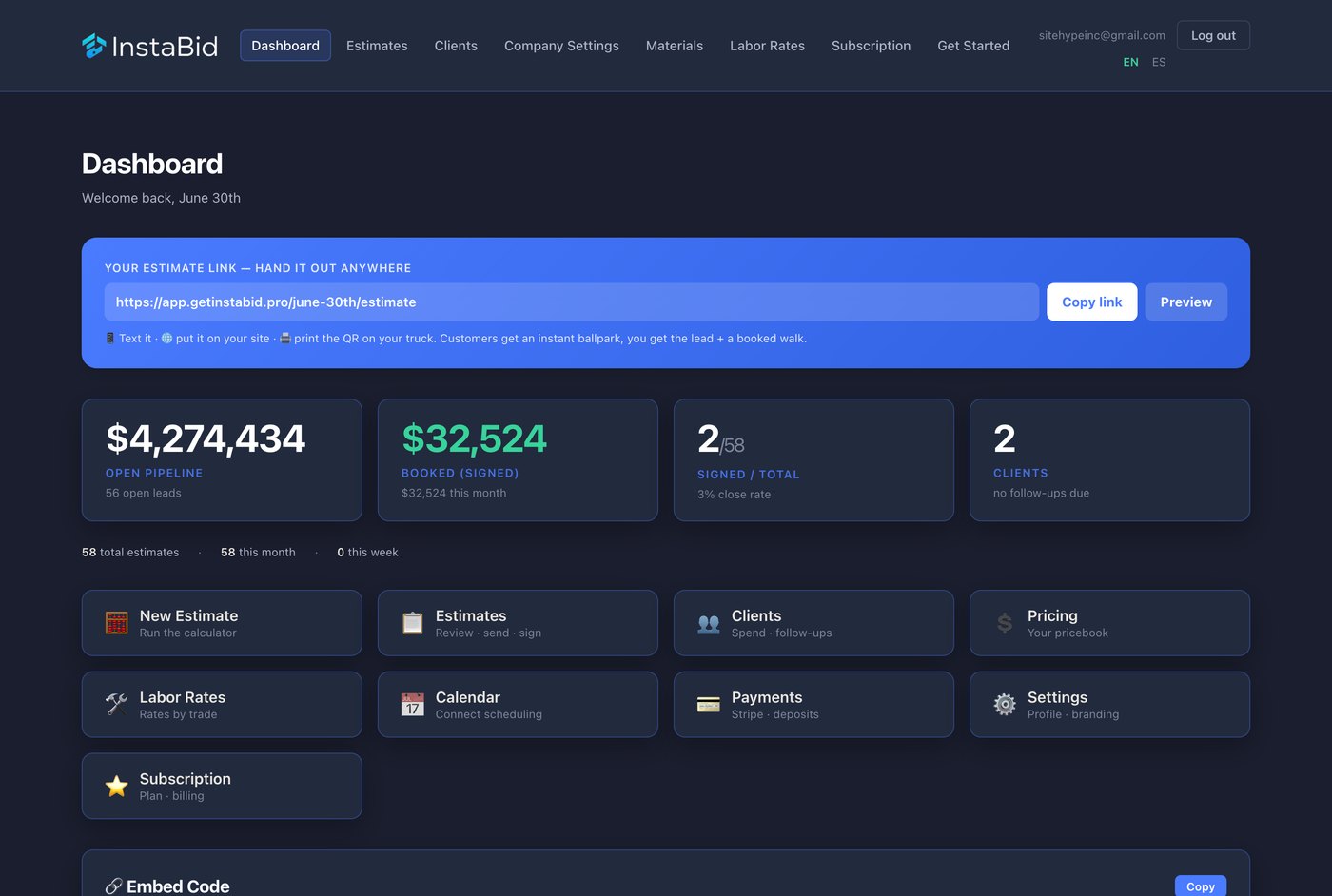
Every estimate is drafted, priced, and sitting there until your thumb says go. That’s the default and you can leave it that way forever.
If you’d rather it just run, there’s a setting for that too — review-first, trust-the-engine, or full-auto. Your leash, your call, and you can change your mind any day.
And you can edit every field before it goes. Which means a wrong number physically cannot reach your customer unless you sent it.
It speaks Spanish
Not a translate button. The whole journey — signup, onboarding, the dashboard, the estimate, the PDF, the email — in real trade Spanish.
496 material names and 212 labor lines translated by hand, and the prices are identical to the penny in either language.
Change orders are English-only in v1.
- 496material names translated by hand
- 212labor lines translated by hand
- $0.00difference in price, English vs Spanish
Stop losing jobs to paperwork.
Walk the job, talk it out, and a real itemized estimate goes to your customer in about two minutes. Early adopters get their first 90 days free.
Claim an early-adopter spot →